
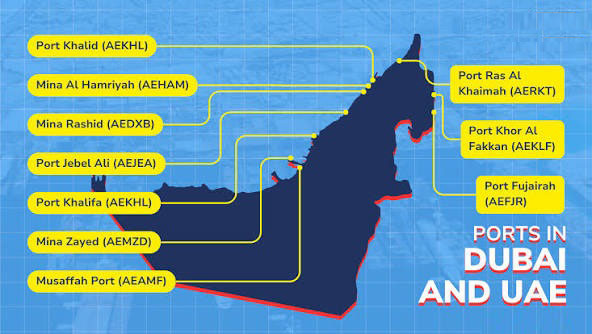
In the UAE, there are worl-dclass seaports which are serving as major global logistics hubs. Main sea-ports in UAE include the Jebel Ali Port (Dubai), Khalifa Port (Abu Dhabi), and Port of Fujairah. Others include Mina Rashid, Mina Zayed, and Khor Fakkan, which handle, container, cargo, and cruise operations.
Major Seaports in the UAE
- Jebel Ali Port (Dubai) – The Region’s Largest Trade Hub: The largest man-made harbor, busiest in the Middle East, and a top-10 global port.
- Operated by: DP World
- Key Features: One of the world’s top 10 busiest container ports, handling millions of TEUs (Twenty-foot Equivalent Unit) annually.
- Role: A critical gateway for cargo movement, serving over 150 shipping lines and connecting to 180 ports worldwide.
- Khalifa Port (Abu Dhabi) – The First Semi-Automated Port in MENA: A major container and cargo port.
- Operated by: Abu Dhabi Ports
- Key Features: A high-tech port covering 420 sq. km with an intermodal transport network linking sea, road, and air.
- Role: Supports the Khalifa Economic Zone (KEZAD) and serves as a key export hub for UAE industries.
- Port of Fujairah – A Critical Oil & Bunkering Hub: A crucial hub on the east coast for oil and maritime services.
- Operated by: Fujairah Port Authority
- Key Features: A multi-purpose port strategically located on the Gulf of Oman.
- Role: One of the world’s largest refueling and oil bunkering ports.
- Mina Rashid (Dubai) – The Leading Cruise Terminal: A prominent cruise terminal and cargo port.
- Operated by: DP World
- Key Features: A dedicated cruise terminal and former cargo hub.
- Role: Plays a major role in the UAE’s tourism sector, welcoming thousands of cruise passengers annually.
- Mina Zayed (Abu Dhabi) – A Legacy Port for General Cargo: Historically the main cargo port, now focused on cruise liners.
- Operated by: Abu Dhabi Ports
- Key Features: Abu Dhabi’s main port for over 40 years, now dedicated to cruise liners.
- Role: Supports maritime tourism and regional trade activities.
- Khor Fakkan Container Terminal (Sharjah) – A Deep-Sea Trade Gateway: A key natural deep-water port on the east coast.
- Operated by: Sharjah Ports Authority
- Key Features: The only natural deep-water port in the region.
- Role: A strategic hub for transshipment trade between the East and West.
- Mina Saqr (Ras Al Khaimah) – A Key Bulk Cargo Port: Specializes in bulk cargo and construction materials.
- Operated by: RAK Ports
- Key Features: Specializes in bulk cargo shipments, particularly construction materials.
- Role: Supports the UAE’s growing infrastructure sector.
- Al Hamriya Port (Dubai): Handles, traditional dhow cargo operations.
Global Maritime Influence of The UAE ports
- 61% of GCC cargo passes through UAE ports, reinforcing its position as a trade leader.
- UAE ports connect to over 70 international destinations, supporting seamless global logistics.
- Ports like Khalifa Port are integrating with Etihad Rail, enhancing intermodal transport efficiency.
Conclusion
From handling bulk commodities to facilitating transshipment and cruise tourism, the UAE’s world-class seaports are central to the nation’s economy and its role in global trade. With continuous investment in maritime infrastructure, the UAE is further strengthening its position as an international logistics powerhouse.
